Just a quick heads-up, I have moved my book reviews over to goodreads.com, as I think they fit better there and have been disrupting the other posts in this blog from time to time anyhow. So if you want to follow my book reviews, check out my page there.
Saturday, February 23, 2013
Saturday, February 16, 2013
Monads for Normal Programmers (part 2)
The first part of this series generated a lot of responses, both very positive ones and very negative ones. I’m quite happy to accept that I just don’t understand monads very well, but so far, no one was able to convince me of that. One of the negative responses claimed it was not possible to actually implement monadic structures using my (simple) definition, which I took as meaning that the idea I was trying to convey was not very clear.
This second part of the series will show an application of the explanation I gave in the first part. I’ll start with a concrete problem and implement it in Python, slowly building up to the ideas encapsulated within monads. I assume you to have a good understanding of Python to be able to focus on the new concepts introduced.

Saturday, February 9, 2013
Elpy 0.8 Released
I’m happy to announce that I just released a new version of Elpy, the Emacs Lisp Python Environment. You can find a list of news since the last release below.
Elpy is an Emacs package to bring powerful Python editing to Emacs. It combines a number of other packages, both written in Emacs Lisp as well as Python.
Sunday, January 27, 2013
Monads for Normal Programmers
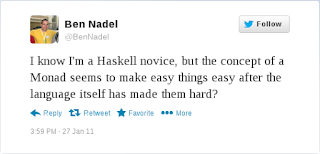
If you know people interested in programming language theory, you will have heard of the monad. Especially in Haskell, they are used extensively. When trying to find out what they are, exactly, the average programmer will have a distinct Matrix feeling, though: You can not be told what a Monad is! Lots and lots of websites try to explain what a monad is, so many that you must wonder what an exceptionally awesome concept this is that it can not be explained in simple, understandable terms, but is still so important that people will not simply give up on using it.
After watching a Google Tech Talk presentation recently, I was enlightened as to how monads can be explained to normal programmers.
Saturday, January 19, 2013
One-Way Functions for Unique Identifiers
A somewhat common but faulty pattern for programmers who need to hide information is to use unsalted hash functions. This does not work. Let me explain.
Tuesday, January 8, 2013
Book Review: A Latent Dark
A Latent Dark
by
In the steampunk novel A Latent Dark by Martin Kee, eleven year old Skyla barely escapes as the house of her mother is burned down. A hunt begins with Reverend Inspector Lyle Summers trying to bring her in to save his church, while Skyla tries to find out what happened to her aunt.
I was positively surprised by this book. It starts out seemingly as a standard witch story, but soon diverges from the normal expectations. In particular, the author manages to created a unique steampunkesque world while telling the story, mostly without delving into infodumps. The world just unfolds while you read the story. This was very well done.
There were a few things that annoyed me, though. A few sections did not advance the plot fast enough, making it laborous to get through them. The author also over-uses deus ex machina resolutions. They do, eventually, have a coherent explanation in the story, but during reading, too many dramatic situations are resolved by unmotivated semi-miracles. And finally, a pet peeve of mine. Stories with a strong fantasy flair should try and avoid modern physics as the main explanatory point. Explaining magic using a modern understanding of subatomic physics just kills immersion for me.
Other than that, a well-written and an enjoyable read. Recommended.
Book Review: Riverwatch
Riverwatch
by
In the mystery novel Riverwatch by Joseph Nassise, construction workers find an ancient statue in an abandondened tomb. When they return with the property owner, the statue is gone, and a corpse is in the tomb instead. Soon, others are killed as well.
The narrative starts out well in the style of Lovecraft, but soon switches to describing the evil explicitly, turning the book from a horror novel I might have enjoyed into a mixture of mystery and splatter which is not exactly my kind of genre. And while the text is mostly written fluidly, the story is a bit too cliché and the characters remain flat and uninteresting thorough the book, so I was actually happy it was over when it was.
I suspect I might have enjoyed the book more if it had been my type of genre. So if you enjoy mystery books about ancient evils splattering in the modern world, you might like it.
Subscribe to:
Posts (Atom)